

IEEE vs. Springer vs. Scopus: 3 Formatting Mistakes That Can Get Your Paper Desk-Rejected
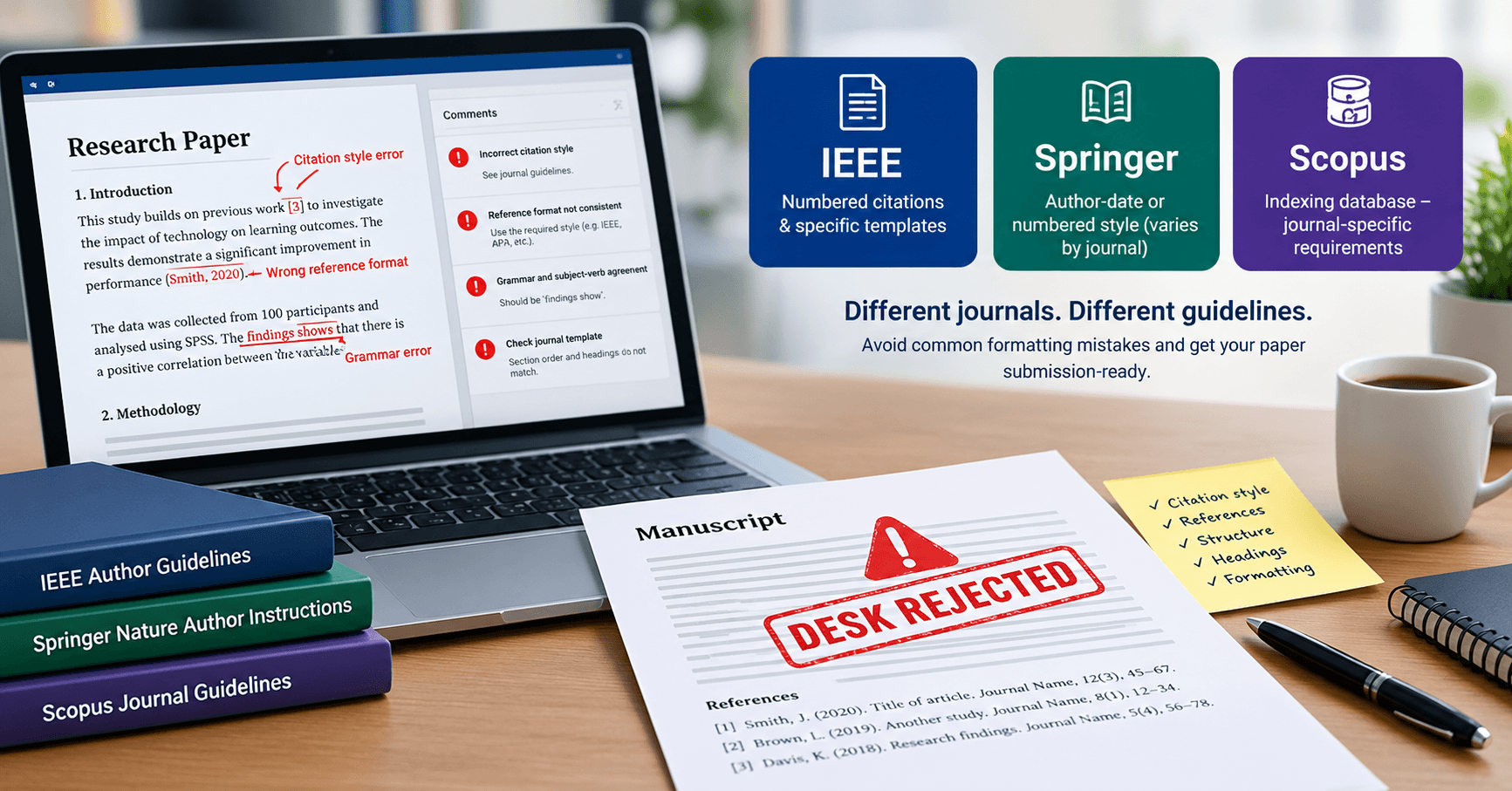
Desk rejection is the worst possible scenario for the author since it occurs before the manuscript undergoes an external peer review. Even though a paper might have some useful research, original findings, and methodology elaborated, it can still encounter difficulties during a preliminary screening if the manuscript does not follow submission requirements of the target journal.
It should also be noted that formatting is very important. As far as some journals and their submission policy are concerned, not following these requirements can lead to returning of the manuscript for corrections, delaying of the paper during screening, or rejecting it before peer reviewing. For instance, Springer Nature recommends that the author follows the Instructions for Authors of the target journal to save the editor's time and not to send the manuscript for reformatting. IEEE offers templates, editorial guidelines, and reference-preparing tools for the authors.
In order to start, one of the clarifications has to be made right away:IEEE and Springer are publishers/organizations with specific publication venues, while Scopus is an abstract and citation database. In other words, there is no one-size-fits-all manuscript format required by Scopus. The manuscript sent to a Scopus-indexed journal should follow the instructions of this journal.
1. Using the Wrong Citation and Reference Style
One of the formatting mistakes that is rather easy to make is assuming that it is possible to transfer citation style from one journal to another one without changing anything.
IEEE publications usually use numbered references in brackets. According to IEEE's current Reference Guide, the references used in the paper appear in square brackets: [1], [2], and [3]. The list of references corresponds to the numbers mentioned in text.
As opposed to IEEE, Springer Nature does not have one reference style for all journals. The publisher's guide mentions several reference styles that are common in various fields of science: basic/Harvard-style references, Vancouver, MathPhys, Physics, social sciences/Psychology, and humanities styles. In other words, the formatting depends on the journal where a paper will be published.
That is why copying the list of references from IEEE manuscript to Springer manuscript, as well as assuming that all Springer journals use the same citation style, can create unnecessary problems.
Common citation mistakes
- Using numbered citations when the target journal uses author-date citations.
- Using author-date citations when the target journal requires numbered references.
- Using mixed citation styles in one manuscript.
- Using punctuation inconsistently in the reference list.
- Mismatch between the in-text citations and entries in the reference list.
- Including uncited references in the bibliography if the journal requires only cited sources.
- Using incorrect reference style generated by reference management software.
IEEE offers a Reference Preparation Assistant to help the authors create references in IEEE format. IEEE's editorial guidance notes that references should always serve the scientific content of the manuscript and should be consistently formatted.
How to avoid the problem
Before finalizing your references, find out the exact target journal. Do not search for the general "Springer style" or "IEEE style" and take the first found reference guide to be applicable to your submission.
Instead:
- Go to the official page of your target journal.
- Study the current Instructions for Authors of the journal.
- Find out the required citation and reference style.
- Use the template or reference style of the target journal where applicable.
- Run the final check of citations/references consistency.
2. Ignoring the Journal Template and Structural Requirements
The second common mistake relates to treating the template of the journal as something optional. In many publication processes, the template communicates much more than just preferences regarding font size or line spacing. It may establish the structure and positioning of various parts of the manuscript.
IEEE offers templates for Word and LaTeX for articles and notes that its templates assist authors in the preparation of the article for publication, including the proper placement of various elements of the text.
Similarly, Springer Nature tells the authors to review the formatting requirements of the target journal, including such things as word/character limits, required sections, language requirements, figure placement, references, image file formats, conflict of interests information and other submission materials.
Problems with structure that may trigger an editorial query or return
- Abstract is longer than the maximum limit stated in the journal.
- Required sections are missing.
- Incorrect hierarchical levels of headings.
- Incorrect manuscript file format.
- Figures are uploaded/placed in a way the journal does not allow.
- Tables violate the requirements of the journal.
- Declarations or other required submission information is missing.
- Failure to use supplied manuscript template if it is required/recommended.
Springer Nature specifically mentions that authors have to follow Instructions for Authors so that editors could move directly to the evaluation of the manuscript without having to return it for reformatting first.
Why this matters
A manuscript may be scientifically sound but still administratively incomplete. The purpose of the editorial screening is partly in determining whether the submission is ready to enter the workflow of the journal. If required information is missing or the manuscript does not meet basic requirements, the editorial team may ask the author to fix these problems before starting the evaluation process.
That is why formatting should be regarded as a pre-submission step.
3. Inconsistent Formatting Across the Manuscript
The third issue is particularly frequent in the manuscripts prepared by multiple authors.
Different sections of the text may be written at different points of time, copied from previous works, revised by different co-authors, or converted between Word and LaTeX. As a result, there may emerge the manuscript where every section separately looks fine but where the whole text is inconsistent.
Examples of inconsistencies
- Different capitalization styles for section headings.
- Different terminology for the same concept.
- Inconsistent use of abbreviations.
- Different citation punctuation.
- Different fonts or font sizes.
- Inconsistent figure and table captions.
- Different space before and after headings.
- Use of both British and American English.
- Inconsistent numbering of sections, equations, tables, or figures.
- References differently formatted since added at different points of time.
Such issues look minor separately but combined together they may make the manuscript seem to be inadequately prepared for submission.
IEEE's editorial guidance covers such issues as punctuation, capitalization, abbreviations, section headings, numbers, equations, footnotes, and references. IEEE's author checklist includes recommendations on using the IEEE article template and validating references before submission.
How to conduct the final consistency check
Do not rely on simply reading the manuscript from the first page to the last. Use a structured checklist.
- Check each level of headings.
- Check terminology and abbreviations.
- Check figures and tables.
- Check formatting of citations.
- Check list of references.
- Check equations and numbering.
- Check page layout and spacing.
- Compare the final version of the manuscript with the template of the journal.
- Perform a review of the submission checklist right before submitting.
What about Scopus Indexed Journals?
This is where authors often misinterpret the system of academic publishing.
Scopus is not a publisher and does not offer a universal manuscript template. It is an abstract and citation database managed by Elsevier. It covers journals, conference proceedings, book series and other resources meeting its coverage criteria.
Therefore, saying that "I formatted my paper according to Scopus style" usually means misleading. The proper approach is to find the exact Scopus-indexed journal and follow its submission instructions.
Elsevier's page on Scopus explains how to find out if a particular title is covered by Scopus. The information is regularly updated, so authors have to verify the coverage of the publication they plan to submit.
IEEE vs. Springer vs. Scopus: what authors actually should check?
| Publication Context | What to Check |
|---|---|
| IEEE publication | Exact publication, IEEE template, editorial style, reference requirements, manuscript structure, figures, equations, and submission checklist. |
| Springer Nature journal | Exact journal's Instructions for Authors, template, reference style, word limits, required sections, figure/table requirements, and declarations. |
| Scopus-indexed journal | Exact journal's author guidelines. Scopus indexing does not mean any universal formatting style. |
Can Formatting Issues Lead to a Desk Rejection?
It is important not to overestimate the connection between formatting and rejection.
Not all formatting errors lead to a desk rejection. Various journals may ask the authors to correct certain mistakes before submission or may ask to fix the issues related to formatting before moving the paper further. Other journals may have stricter screening procedures.
The outcome will depend on the particular journal, nature of the problem, and the editorial workflow.
What follows from the guidance of publishers is that authors have to follow the instructions of the target journal. Springer Nature explicitly warns that manuscripts may be returned to authors for reformatting, while IEEE offers templates and validation tools to assist authors in preparing compliant submissions.
Therefore, the real lesson is not in the fact that each formatting error automatically results in rejection. The lesson is in the fact that formatting compliance is a part of submission readiness and helps avoiding unnecessary delays or screening issues.
Final Pre-Submission Formatting Checklist
Before pressing the Submit button, check the following.
Journal requirements
- Have I chosen the correct target journal?
- Have I studied its current Instructions for Authors?
- Am I using the correct manuscript template?
- Have I checked the current word and character limits?
Citations and references
- Are my citations in the correct journal's style?
- Do all in-text citations correspond to the references?
- Is the reference list consistent?
- Have I deleted duplicates?
- Have I checked DOIs, URLs, author names, titles, and publication information?
Structure and presentation
- Are all required sections present?
- Are headings consistent?
- Are figures and tables numbered correctly?
- Are figures and tables cited in the text where required?
- Are captions formatted correctly?
- Are equations numbered consistently?
- Is the manuscript in the required file format?
Final quality check
- Have all co-authors reviewed the final version?
- Have the changes tracked and comments are resolved and deleted?
- Have I checked the final PDF/generated submission file?
- Have I verified all declarations and submission information?
- Have I checked the submission checklist of the journal one more time?
Conclusion
Formatting should never be considered an afterthought in preparation of a research paper for publication.
Three most avoidable problems are: using the wrong citation style, ignoring the template of the target journal and its structural requirements, and allowing inconsistent formatting after several rounds of writing/revision.
There is also an important difference between the three terms used in the title. IEEE offers its own publication templates and editorial/reference guidance. Springer Nature publishes many journals with different Instructions for Authors and reference styles. Scopus is an indexing and abstracting database, not a publisher with the universal format of the manuscript.
Therefore, the safest way is simple - first choose the exact journal, then study its current Instructions for Authors, use the template if possible, validate your references and perform a final formatting check before submitting.
Need a Final Manuscript Formatting Check?
If your research manuscript is ready but you are concerned about formatting, references, headings, tables, figures, or consistency, a dedicated pre-submission review can help identify issues before you upload the manuscript.
References and Official Source Websites
- IEEE Author Center — IEEE Article Templates
- IEEE Author Center — IEEE Editorial Style Manual
- IEEE — Reference Guide
- IEEE Author Center — Checklist for Creating Your Article
- Springer Nature — Formatting
- Springer Nature Support — Templates and Style Files
- Springer Nature Support — Locate Submission Instructions for a Springer Journal
- Elsevier — Scopus: Abstract and Citation Database
- Elsevier — Scopus Content and Source Information