

Real Before-and-After: How Academic Editing Transforms an ESL Manuscript
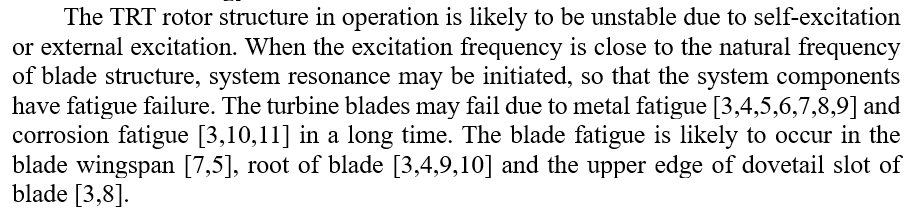
Guidance related to scholarly editing has mostly been theoretical in nature. It is often stated that clarity is important, that grammar creates the impression of rigor in the mind of a reviewer, and that errors add up. However, it is rare to see evidence of these claims being put to work. The following piece of writing serves as a practical example of academic editing. It is an excerpt from an engineering manuscript, written in its original form and in its edited version, with detailed explanations of all the edits made.
The original text does not contain mistakes in the language used. The technical part is accurate, the argument is clear, and there will be no problems comprehending the passage for the reader who has enough expertise in the field. This aspect of the excerpt along with the editing of the well-written text makes the example very useful when explaining the editing process.
The Original Sentence
The following passage concerns the problem of rotor blade fatigue in turbine systems – a technically complicated and highly referenced paragraph that can be found in most engineering papers:
Rewritten Text
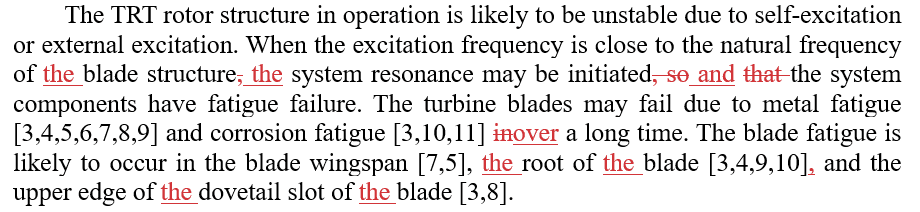
Changes Made, and Rationale
Usage of articles with technical terms. The wording “of blade structure” was changed to “of the blade structure,” as well as “Root of blade” to “the root of the blade.” This is the most common pattern found in ESL academic papers, and its significance is far from negligible. In the context of technical language that is dense and highly compressed, the absence of articles makes things harder for the reader, each omission being the cue to the reviewer that the paper might not have been edited properly by a native speaker of English, no matter how scientifically correct the content is.
Conjunction structure. The original wording had the construction “so and that the system components have fatigue failure,” where “so and that” is not correct in English. The revised wording is “and the system components have fatigue failure,” retaining the sense of causation but removing the ambiguity.
Preposition choice. The wording “fail… in a long time” was corrected to “fail… over a long time.” Here, the use of the preposition “in” implies a specific point in time, while the use of “over” implies duration. This is indeed what the sentence means.
Why It Is Important for Your Submission
The above mentioned modifications do not impact your research itself. Claims, citations and the argument itself do not change. The difference lies in how easy it becomes for a reviewer to see that an argument is made by a person who has mastered the material fully.
Expression errors and conjunction problems do not affect the validity of your research but make it look less convincing because they create an image of uncertainty, which is different from the reliability of your findings. Furthermore, this problem is easier to fix, provided that you manage to spot it before submission rather than during the review process.
If you plan to submit a dissertation, a thesis or a paper to SCI-indexed, Scopus-indexed, IEEE or Springer journals, it is advisable to have your work reviewed a second time to find this particular issue. Unincluded articles, awkward conjunctions and inaccurate prepositions are often hard to notice because of the author's understanding of the meaning behind his or her words.
Want to see this kind of feedback applied to your own work? I offer a free 500-word sample edit — no obligation, just a chance to see the difference before you commit. Contact / Services Page